Biosecurity
Pork production is an important component of food security, the economy, and local and international trade. In addition, Canada is one of the world’s largest exporters of pork and pork products. Biosecurity plays an important role in pork production.
A direct link has been established with the technical and economic performance and health of pig herds, and its impact on farm profitability. Losses due to contagious diseases such as porcine reproductive and respiratory syndrome (PRRS), porcine epidemic diarrhea virus (PED), Porcine deltacoronavirus (PDCV), Senecavirus A (SVA) and swine influenza cost producers in North America hundreds of millions of dollars annually.
The globalization of the swine industry and climate change have contributed to the emergence and spread of pathogens, including African swine fever (ASF) virus, which affects Europe, Asia and the island of Hispaniola in America, in addition to Africa. The risk of their introduction into Canada through animal products or by travellers carrying contaminated food is real and endangers the entire Canadian pork industry by stopping exports when a case is confirmed.
The Équipe quebecoise de santé porcine (EQSP) wishes to raise awareness among all stakeholders in the pork sector about the application of biosecurity measures in health emergencies. The EQSP works in collaboration with government authorities to monitor and prevent reportable diseases in Quebec in order to prevent their spread in our herd and minimize their impacts.
In Canada, reportable diseases are the responsibility of the Canadian Food Inspection Agency (CFIA) and the most important for the swine sector are:
| • Foot and mouth disease
• Aujeszky’s disease (or pseudorabies) • Swine vesicular disease |
• African swine fever
• Classical swine fever • Vesicular stomatitis |
Biosecurity Protocols
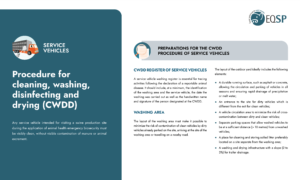
Should the sector face an outbreak of one of these diseases, enhanced biosecurity protocols are available for producers and their employees, visitors and service vehicles.
Their application, proactively or at the request of the EQSP, is recommended on a swine production site suspected or confirmed to be infected with the presence of a reportable disease in swine, on a site linked to it or located in a high-risk disease zone determined by the EQSP or the CFIA. They are in addition to the biosecurity protocols commonly used on swine production sites.
The CFIA prescribes biocontainment conditions requiring a permit for movement on a production site designated as high-risk or confirmed for a reportable disease and for movement on production sites located in a Primary Control Zone (PCZ) established following confirmation of a reportable disease on a swine site.
Click on the image to open the PDF file
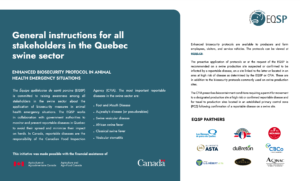
Click on the image to open the PDF file
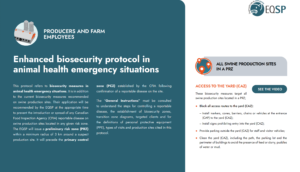
Click on the image to open the PDF file
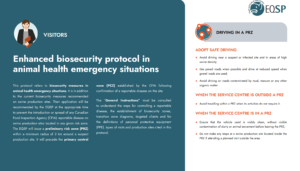
Click on the image to open the PDF file
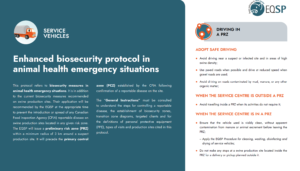
Click on the image to open the PDF file